
Retrenched in Singapore? What to Do in the First Week and Where to Get Help
· 7 min read
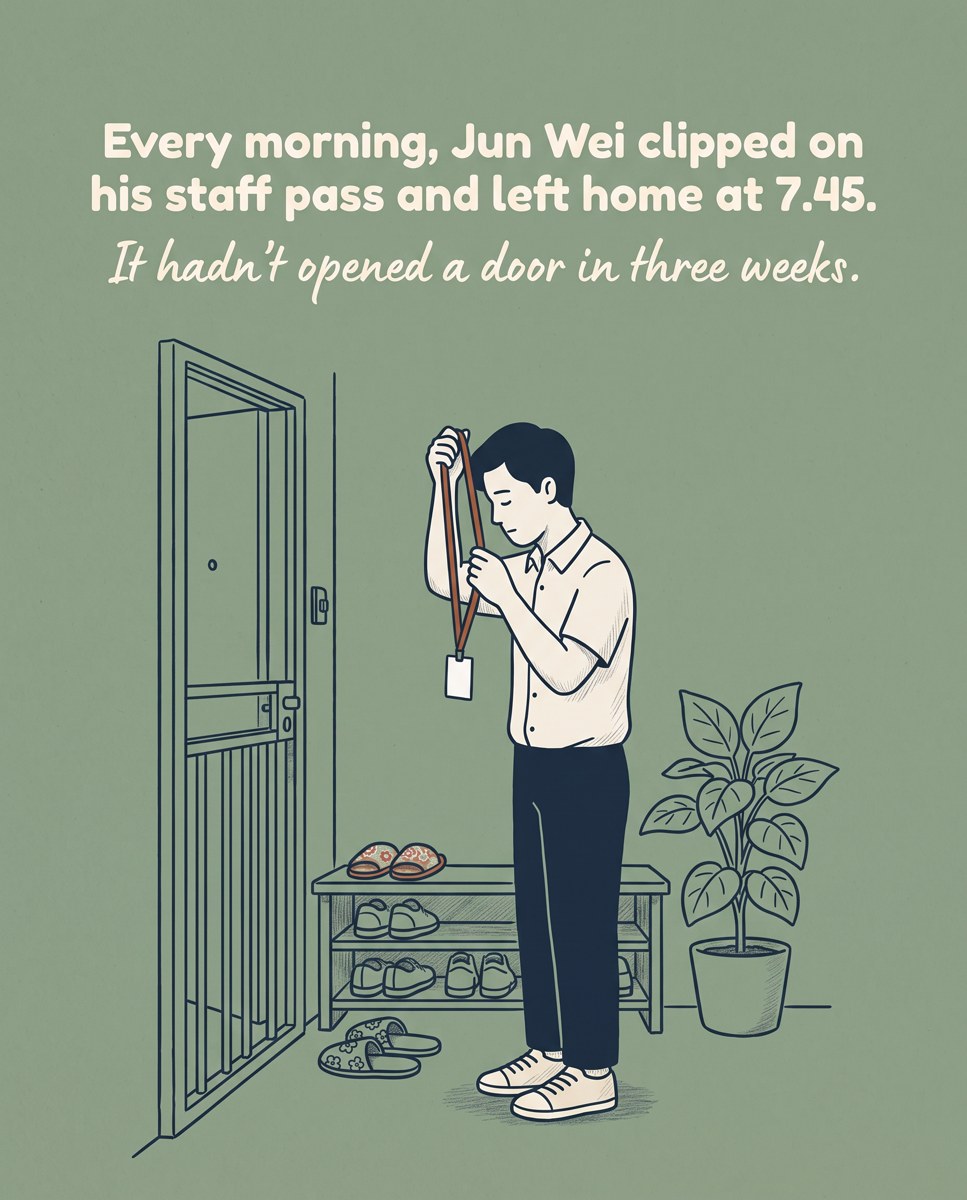
The staff pass
If you lose your job, the money problem has a checklist. The harder part is usually the silence, so this guide covers both: what to do in the first week, how to work out how long you can last, who to tell, and where to get help in Singapore.
Jun Wei is made up, but plenty of people will recognise him. For three weeks after his role was cut, he still clipped on his staff pass every morning and left home at 7.45. He took the same train, bought the same kopi and spent the day at the library sending applications. At dinner, his mum asked how work was. "Busy," he said.
He wasn't trying to fool anyone. Telling his family felt like failing twice: first the job, then the worry on his mum's face. Keeping quiet felt kinder. It also meant he made every decision alone, without knowing how long his savings could last or that help existed.
In week four he told his sister. They sat down with his bank app and worked out how many months he could cover. It was more than he'd feared. A week later he told his parents, and his mum's first question was "You eat already or not?"
You're less alone than it feels
Between April and June 2026, 4,620 people in Singapore were retrenched, or about 2 in every 1,000 employees. That's up from 3,830 in the first quarter, according to MOM's Labour Market Report for Q2 2026.
Getting back to work is taking longer, too. Of retrenched residents, 54.9% found a new job within six months, down from 60.7% the quarter before. Within a year, it was 69.8%.
Read those two numbers together. About half of people are back within six months, and most within a year, but a real share take longer. Planning for a longer search is sensible, and needing one says nothing about you.
The first week: a checklist
In the first few days you'll be tired and probably a bit numb, so keep this list short and practical. Tick these off before you think about anything bigger.
- Get it in writing. Ask for the retrenchment letter with your last day, notice period and what you'll be paid.
- Check the retrenchment benefit. If you've worked there 2 years or more, MOM's guidance says the norm is 2 weeks to 1 month of salary per year of service. Under 2 years, any payment is at the company's goodwill.
- Check your last pay. MOM's guidance is that salary, unused annual leave and notice pay are paid on your last day. Keep your payslips.
- Know that no CPF comes off the retrenchment benefit. Neither you nor your employer contributes CPF on it, so the amount in your letter is what you should receive.
- Ask HR when your company insurance ends. Group hospital, life or dental cover is usually tied to your job. Find out the end date so nothing lapses without you knowing.
- Ask for a reference letter and save your work contacts before your email access goes.
- Ask about outplacement help. MOM asks employers to help retrenched staff find other jobs, including through outplacement support from e2i or SWDA. Ask HR what's been set up for you.
If pay you're owed doesn't arrive, the Tripartite Alliance for Dispute Management (TADM) handles salary claims.
Work out your runway
Your runway is the number of months you can cover your essentials with no salary coming in. Jun Wei's turned out longer than he feared, and knowing it changed how he searched. It takes about 30 minutes with your bank app and last month's bills.
- Add up what you can reach. Count cash in your bank accounts, your retrenchment payout and final pay, and any support you qualify for (see below). Leave out CPF, investments you'd have to sell at a loss, and money you've promised to someone else.
- List your must-pay bills for one month. Include housing, food, transport, phone, insurance premiums, loan repayments and what you give your parents. Use real numbers from your statements, not guesses.
- Divide. Money you can reach ÷ must-pay bills = months of runway.
- Find your cut list. Go through the bills again and mark anything you could pause or cancel for now, like subscriptions, gym, or eating out. Work out the runway again with those removed. Most people find the second number is noticeably longer.
- Write both numbers down. Your runway and your runway after cuts are the two numbers worth telling the first person you confide in.
An example, with made-up figures: $18,000 you can reach ÷ $3,000 of monthly essentials = 6 months. Pause $400 of extras and essentials drop to $2,600, which gives about 7 months.
If your runway is short, that's useful to know early. It's the moment to call HDB or your bank about your loan, and to apply for support, before payments are missed.
Who to tell, and what to say
Tell one person first, someone who will listen before they react. For Jun Wei it was his sister. For you it might be a partner, a friend or a former colleague. Once one person knows, you're no longer making every decision alone, and the next conversation gets easier.
It helps to have your runway worked out before the bigger conversations. A worried parent asks "how are you going to manage?" A number answers that better than "I'll be fine."
Some lines you can borrow and change:
- To the first person: "I need to tell you something and I'm a bit embarrassed. My role got cut three weeks ago. I'm okay, I just don't want to keep carrying it alone."
- To a partner: "My job's ending on [date]. I've worked out we can cover about [X] months. Can we look at the plan together this weekend?"
- To parents: "My company cut some roles and mine was one of them. I've got some savings and I'm already applying. I'll update you every couple of weeks."
- To friends or your network: "I'm looking for my next role in [field]. If you hear of anything, I'd really appreciate a shout."
The last one matters more than people think. Many jobs come through someone who knew you were looking.
Help you can use in Singapore
Apply early, while you still have runway. Some need an appointment or approval before help starts.
| Support | What it gives you | Who it's for | How to start |
|---|---|---|---|
| SkillsFuture Jobseeker Support | Up to $6,000 over 6 months, paid for months you do job-search activities like career coaching and applications | Citizens 21+ (PRs from Q1 2026) who lost their job involuntarily, averaged $5,000 or less a month, worked 6 of the last 12 months, and live in a home with Annual Value of $31,000 or less | Apply at go.gov.sg/jobseekersupport, or call 6883 5885 |
| WSG Careers Connect | Career advice, a career coach and workshops | Anyone looking for work | Call 6883 5885 or visit 11 Eunos Road 8 #02-02 |
| NTUC e2i | Career coaches and job matching; also runs outplacement with employers | Anyone looking for work | Call 6474 0606 to book a coach |
| Career Matching Providers | One-to-one job matching | Retrenched workers and jobseekers actively searching | Register interest on the WSG page; by appointment |
| HDB loan help | Rescheduling your loan, or reducing or deferring instalments for a period | HDB flat owners with an HDB loan who are struggling to pay | Write to HDB at go.gov.sg/hdb-write-to-us, or book an appointment at your HDB branch |
| Bank loans and insurance premiums | Possible loan restructuring; for insurance, options such as premium holidays, premium loans or paid-up conversion, depending on your policy | Anyone with a private home loan or insurance premiums | Call your bank or insurer early, before you miss a payment |
| ComCare Short-to-Medium Term Assistance | Help for households in financial difficulty | Households struggling to meet basic needs | Ask at your nearest Social Service Office |
On insurance: call your insurer or adviser before changing anything. Cancelling a policy during a job search can leave gaps that are hard to fill later, especially if your health changes.
If it hasn't happened to you
Most of what made Jun Wei's month hard could have been sorted on a quiet weekend beforehand. None of this needs you to expect a retrenchment. It just makes a bad week less frightening if one comes.
- Work out your runway now, using the steps above. Write the number somewhere you'll find it.
- Check what your company insurance covers, and what you'd have left if it stopped. Your HR portal or benefits guide will list it.
- Keep your CV current. Add your latest role and results while you still remember the numbers.
- Stay in touch with a few people outside your company, like old colleagues or your industry group. A quick coffee every few months adds up.
- Decide who you'd tell first. It sounds strange, but knowing the answer makes it easier to pick up the phone.
- Save the numbers in the table above in your phone: 6883 5885 for WSG and 6474 0606 for e2i.
Some honest caveats
- If this is you right now, we're sorry. There's no right week to tell people, and you don't owe anyone a timeline.
- Not everyone has savings to count or family who'll react kindly. If that's you, start with one friend or a career coach, and look at the support table first.
- Job searches often take longer for older workers and in some industries. Six months is an average.
- The schemes above have their own rules, and those change. Check each official page before you rely on it.
Our 5 cents
Losing a job hurts your money and your pride, and the pride part gets heavier when you carry it alone. The money side has a checklist. The pride side needs one other person. Work out your runway, then tell someone, in that order if it helps.
If it happened next month, who would you tell first? And roughly how many months could you cover? Knowing both now could make that week a little lighter.
This post is our opinion and general commentary, not financial advice. We are not licensed financial advisers. Everyone's circumstances are different — please speak to a MAS-licensed adviser before making any financial decisions.
Sources
- MOM: Labour Market Report, Second Quarter 2026 (21 Sep 2026)
- MOM: Responsible retrenchment
- WSG: SkillsFuture Jobseeker Support
- WSG: Careers Connect, e2i centres and Career Matching Providers
- CPF: How do I apply for HDB financial assistance measures?
- MOM: Written answer on support for unemployed persons facing financial difficulties (Sep 2024)
Enjoyed this? Follow @fivecents.co on Instagram for more.