
Starting a Side Hustle in Singapore? What It Can Give You, and What to Check First
· 7 min read
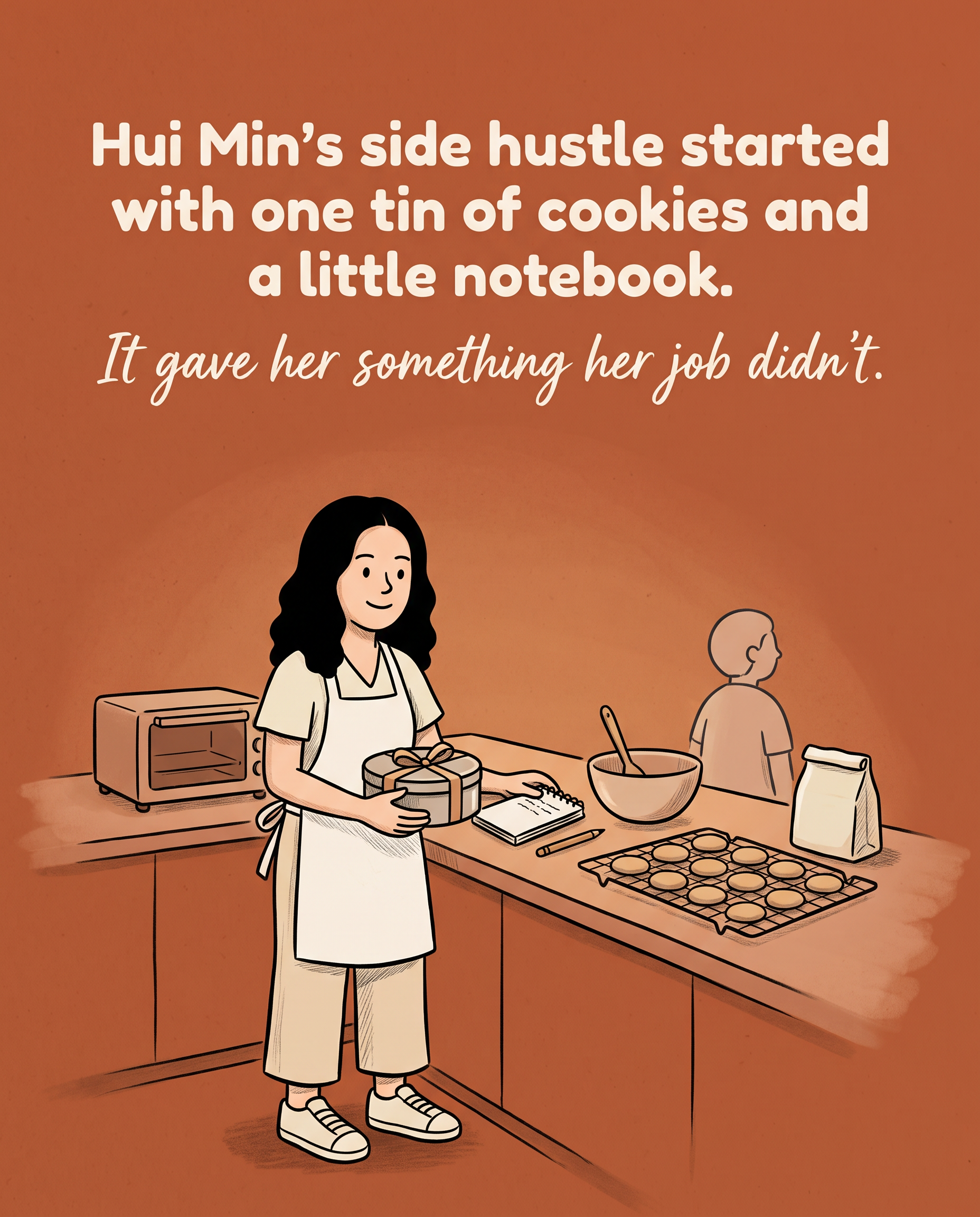
The cookie order notebook
Hui Min baked a tin of cookies for a colleague's birthday. Before the cake was even cut, someone asked if they could buy a tin of their own. She found an old notebook in a drawer and wrote the first line: "Order 1: Auntie Lim, one tin."
By December the notebook was nearly full, and the same names kept coming back for festive tins.
At work, she was good at her job and mostly invisible in it. Her projects went into a long chain of emails, and she rarely saw who they helped. With the job market the way it is, the next step up felt like a long wait. The tarts were different. She picked the recipe, set the price, and got the "your tarts made my mum's day" message herself.
Hui Min is made up. Her notebook isn't. Plenty of home bakers, tutors, designers and weekend freelancers keep one just like it.
Why so many of us start side hustles now
Ask people why they started, and the extra money usually comes up first. It's rarely the whole answer.
For some, a side hustle is a backup. When work feels uncertain, having a second thing that people already pay for makes the ground feel a little firmer.
For others, it's a skill their day job never asks for. You might spend your weekdays in spreadsheets and your weekends shooting portraits, and the weekend version of you gets to use a part of your brain that's been idle since school.
And for a lot of people, it's the only place where they own the whole thing, from start to finish. At a big organisation you're often one step in a long process. With a side hustle you decide what to make, what to charge and who it's for, and when it goes well you hear about it directly.
A full-time job pays the bills. It can't always give you ownership, or a reason to work that feels like your own, and that gap feels bigger when promotions are slow and teams are cautious. A side hustle can fill some of it, even a small one.
What to know before you earn on the side
The fun part of a side hustle is the making. The less fun part is that, once money changes hands regularly, a few rules apply. Here's what the official sources say.
It counts as income, even if it's part-time. IRAS lists the owner of a home-based food and beverage business (baking and cooking are its examples), freelancers, private tutors, online sellers and live commerce streamers as examples of self-employed individuals. You can be an employee and self-employed at the same time, and the side income goes into the "Trade, Business, Profession or Vocation" section of your tax return.
A hobby becomes taxable when it becomes a habit. IRAS says money from a hobby or pastime generally isn't taxable, but it becomes taxable if the activity is done repeatedly or habitually in exchange for money or other benefits. Selling your own used things that you bought for personal enjoyment is generally not treated as business income.
When you need to file. A self-employed person needs to submit a tax return if, in the previous calendar year, their total annual income was more than $22,000 or their self-employment net profit was more than $6,000. Filing runs from 1 March to 18 April. If your revenue is $200,000 or less, you fill in a simple 2-Line Statement: revenue, and adjusted profit or loss.
Keep your records. IRAS asks self-employed individuals to keep full and accurate records of all business transactions from the start, and to retain them for at least five years. Hui Min's notebook would count as a decent start.
MediSave comes in above $6,000. CPF Board says that if your annual net trade income is more than $6,000, you're required to contribute to your MediSave Account. This is on top of the CPF you already pay through your job.
A business name may need registering. ACRA says you need to register if you carry out an activity for profit on a regular basis, including home-based and online businesses, or if you use any name other than your own full NRIC name. Using only your full NRIC name is one of the exemptions, and the full list sits in the Business Names Registration Act.
Home-based food businesses have their own rules. Under the HDB/URA Home-based Business Scheme, you don't need HDB or URA approval if you meet all the scheme's requirements. HDB's version is for household members only and shouldn't disrupt your neighbours. SFA adds that home-based food businesses still have to follow food safety laws, can't sell to food retailers such as cafés or hawker stalls, and can't sell ready-to-eat raw seafood.
Try the four-column check
This is the exercise Hui Min's notebook turned into. It takes about 20 minutes and works whether you've been selling for years or haven't started yet.
- Pick last month. One month is enough to see a pattern without drowning in receipts.
- List each thing you sell or do. For a baker that might be tarts, cookies and custom cakes. For a tutor it might be each student or each subject.
- Fill in four columns for each one. Money in. Costs (ingredients, packaging, delivery, platform fees, transport). Hours, including shopping, prep, messaging and clean-up. And the fourth: did it feel like yours?
- Look at the rows side by side. Circle the ones you'd keep doing even on a tired week. Put a question mark next to the ones you're only doing because someone asked.
Here's a made-up example of what Hui Min's November might look like:
| What she sold | Money in | Costs | Hours | Felt like hers? |
|---|---|---|---|---|
| Pineapple tarts | $420 | $150 | 10 | Yes, her own recipe |
| Custom cakes | $220 | $110 | 12 | Not really, mostly other people's designs |
| Total | $640 | $260 | 22 |
On paper the month made $380. Row by row, the tarts made about $27 for each hour and felt like hers, while the custom cakes made about $9 an hour and felt like work she was doing for someone else. That doesn't mean the cakes were a mistake. It means she now has a reason, written down, for which orders to say yes to.
No side hustle yet? Try the columns on the idea you keep thinking about. Guess the money and costs, be honest about the hours, and ask the fourth question first.
Where to check or get help
| Resource | Who it's for | How to start |
|---|---|---|
| IRAS: Am I a self-employed individual? | Anyone earning on the side who isn't sure if it counts | Read the list of examples and the hobby note |
| IRAS: Filing responsibilities of self-employed individuals | Side earners filing for the first time | Check the $22,000 and $6,000 filing criteria, then file on myTax Portal from 1 March |
| CPF Board: MediSave for the self-employed who are also employees | Anyone whose side profit may go above $6,000 a year | Read the FAQ and check your CPF account after you file |
| ACRA: Requirements and eligibility | Anyone trading regularly or using a business name | Check whether you need to register or fall under an exemption |
| HDB: Home business | HDB residents running something from home | Read the Home-Based Business Scheme conditions |
| SFA: Home-based food businesses | Home bakers and cooks | Read the scheme conditions and SFA's food safety guidelines |
What to check before you start
Have you read the line in your employment contract about outside work? Many contracts have one, and some jobs, especially in the public service and regulated industries, have stricter rules. HR can tell you what applies to you.
Do you know where your records will live? A notebook, a spreadsheet or a notes app all work, as long as money in and costs are written down as they happen rather than reconstructed in April.
Do you know roughly how many hours a week you can give it without your sleep, your family or your day job paying for it?
The honest caveats
If your job already gives you ownership and a sense of purpose, that's great. Hold on to it. This isn't a case for everyone needing a second thing.
If you're between jobs right now, a side hustle isn't a replacement for one, and nobody should make you feel it has to be. Be kind to yourself first.
If you don't have the time or energy for one because of family, health or a heavy job, that's a real reason. Rest counts too.
If your side income already helps cover the bills, that's an achievement, however small it looks on paper. And if you tried one and it didn't take off, you still learned what people will and won't pay for.
Our 5 cents
A side hustle can give you more than extra money. It can give you a skill you get to use, proof that you can start something, and a small corner of your week that's entirely yours. Your job doesn't have to give you everything.
The notebook is what keeps it that way. So, a few questions to sit with:
- Could you fill in all four columns for last month?
- Which part of your side hustle would you keep, and which would you drop?
- What does it give you that work doesn't?
That's just our 5 cents.
⚠️ This post is our opinion and general commentary, not financial advice. We are not licensed financial advisers. Everyone's circumstances are different — please speak to a MAS-licensed adviser before making any financial decisions.
Sources
- IRAS, Am I a self-employed individual?
- IRAS, Filing responsibilities of self-employed individuals including individual partners
- CPF Board, Do I still have to contribute to my MediSave if I am a self-employed person and an employee and/or a platform worker?
- ACRA, Step 1: Understanding requirements and eligibility
- HDB, Home business
- SFA, About HDB/URA Home-based Business Scheme
Enjoyed this? Follow @fivecents.co on Instagram for more.