
Supporting Your Parents in Singapore: The 4 Money Stages and What to Check at Each
· 8 min read
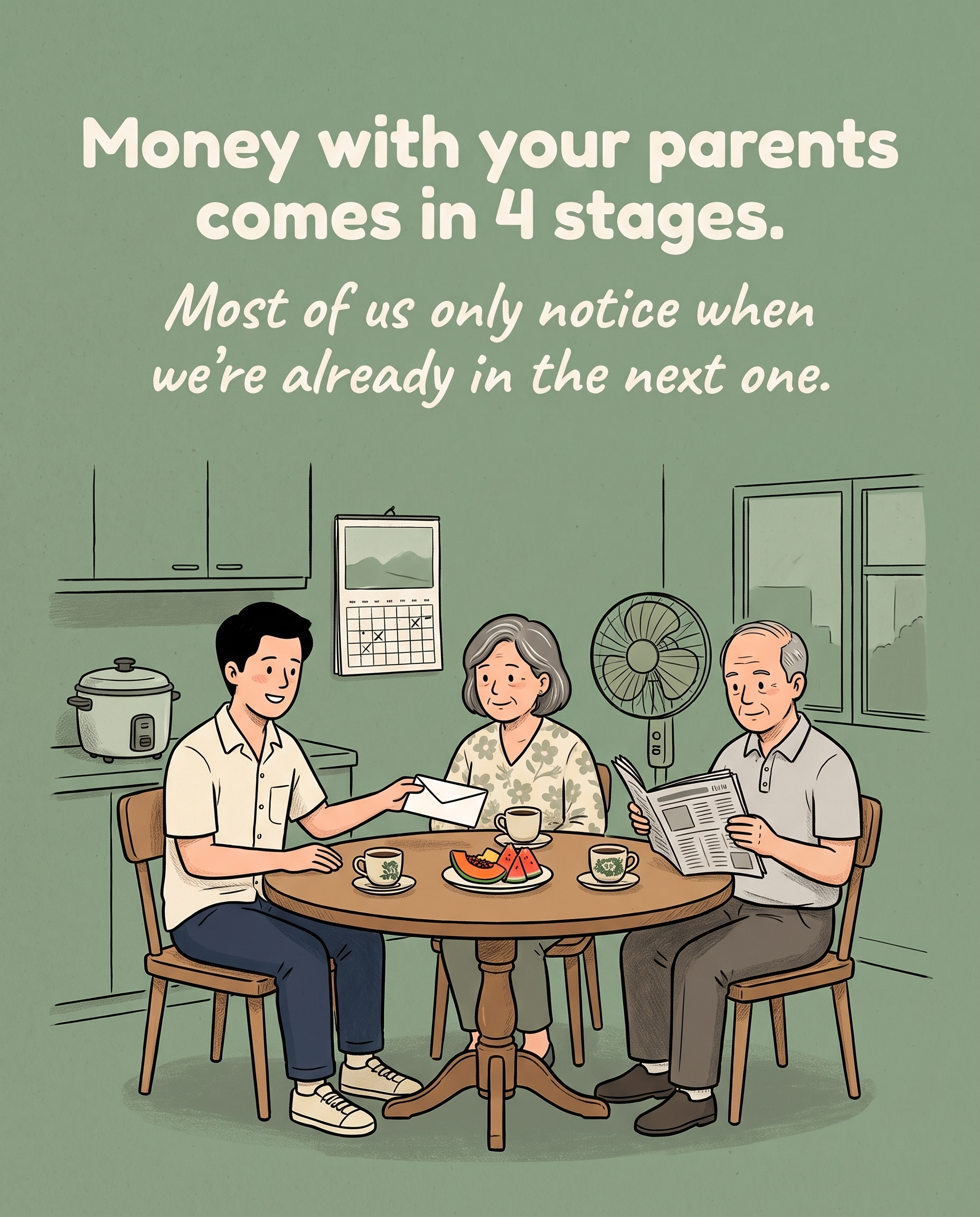
Money with your parents comes in 4 stages
Darren is made up, but his envelope probably isn't. The month he got his first payslip, he put some cash in a plain envelope and slid it across the dining table to his mum. Nobody had told him how much. He picked a number that felt respectful and not too showy, and that number stayed the same for six years.
Then his dad retired, and the envelope turned into part of the household budget. Two years later, his mum spent four nights in hospital, and Darren and his sister stood at the payment counter trying to work out, on the spot, who would cover what. Last year his mum asked him, half joking, who would "sign things" for her if she ever couldn't.
None of these moments came with a warning. Most families go through some version of them, usually in roughly this order:
- Your first payslip. You start giving an allowance.
- They stop working. Your allowance may become part of what they live on.
- The first big medical bill. The family has to split a cost, often in a hurry.
- Deciding for them. The question shifts from "who pays?" to "who decides?"
Each stage is easier if you've seen it coming. This guide walks through what each one looks like, what's worth knowing, and a few questions you can check against your own family.
Why these talks are so hard to start
Money between parents and children is rarely just money. The allowance is part thank-you and part duty, so changing the amount can feel like changing how much you care. Asking what your parents live on can sound like you're checking up on them. Bringing up hospital bills or who decides for them can feel like you're expecting the worst.
So most families wait. The trouble is that each stage tends to arrive on a bad day, when someone is tired, worried or standing in a hospital corridor. Talking a little earlier, when nobody is in a hurry, usually goes better.
Stage 1: Your first payslip
What it looks like: You start giving your parents an allowance. Nobody tells you the number, so you guess, and the guess sticks.
Why it's harder than it seems: The amount often reflects what felt right at 23, not what you or they need now. Raising it, lowering it or changing how it's paid can feel loaded.
Something worth knowing: If you're thinking about supporting your parents' retirement in a more lasting way, CPF lets you make cash top-ups to a loved one's retirement savings. You can get tax relief of up to $8,000 a year for top-ups to loved ones, separate from the $8,000 for your own account, up to the current Full Retirement Sum. From 1 January 2025, a top-up that earns the Matched Retirement Savings Scheme grant no longer gets tax relief. Whether this suits your family is a different question, and a good one for an adviser.
Self-check: Did you choose your amount, or did it just happen?
Stage 2: They stop working
What it looks like: Your allowance used to be a gesture. Now it might be part of what they live on.
Why it's harder than it seems: Retirement income usually comes from several places, and most parents never walk their kids through it. You may not know whether your allowance is a top-up or a lifeline.
Something worth knowing: CPF LIFE monthly payouts can start any time between age 65 and 70. CPF says each year of deferral raises payouts by up to 7%, up to 35% if they start at 70, and if no start age is chosen, payouts begin automatically at 70. Knowing roughly when your parents' payouts start, or started, tells you a lot about how much your allowance matters.
Self-check: Do you roughly know what else they live on?
Stage 3: The first big medical bill
What it looks like: A bill lands, and the family has to work out who pays what, fast.
Why it's harder than it seems: These splits usually get decided in a hurry, by whoever happens to be there. The sibling who lives nearest, or who earns most, can end up carrying more without anyone deciding that out loud.
Something worth knowing: You can use your own MediSave to help pay a parent's hospital bill. CPF says approved dependants include your spouse, children, parents, grandparents and siblings (grandparents and siblings must be citizens or PRs). It's subject to MediSave withdrawal limits for each hospital stay, and anything above that is paid in cash. The hospital will ask you to sign a Medical Claims Authorisation Form.
Self-check: If a bill came tomorrow, would your family know who covers what?
Stage 4: Deciding for them
What it looks like: One day the question shifts from "who pays?" to "who decides?"
Why it's harder than it seems: It feels awkward to bring up, so many families leave it until a crisis, when it may be too late to ask your parent what they want.
Something worth knowing: A Lasting Power of Attorney (LPA) is a legal document that lets anyone aged 21 and above choose trusted people, called donees, to make decisions on their behalf about personal welfare and property and affairs. Without one, MSF says loved ones need to apply for a deputyship order to make those decisions. As of 20 February 2026, about one in four Singapore citizens above 65 had made an LPA, and MSF said Form 1 applications would stay free for citizens even after the current fee waiver ends.
Self-check: Do you know who they'd want to decide for them?
A 20-minute self-check
You don't need a family meeting to start. Sit down alone with a notebook and answer these. Leave blanks where you don't know. The blanks are the useful part.
- Which stage are you at? Write down the stage that fits best. It's fine if you're between two.
- Your allowance. How much do you give, how often, and when did you last change it?
- Their income. List what you think your parents live on: work, CPF payouts, savings, rent, support from siblings. Mark each one "know" or "guess".
- The bill plan. If a parent were in hospital next week, who would pay, and from what? Would your siblings agree?
- The decision-maker. Has either parent made an LPA? If not, do you know who they'd pick?
- One question. Pick one blank and turn it into a question you could ask this month.
A made-up example: Mei is 32, an only child, and gives her parents an allowance each month. Her dad turns 65 next year. She writes "Stage 1, nearly Stage 2". Under income, she has two "guess" marks: she doesn't know when her dad's CPF payouts start or whether her mum has any. Under the decision-maker, she has a blank. Her one question for this month: "Pa, do you know when your CPF payouts start?" It's a small, low-stakes way in, and the answer helps her see how much her allowance matters.
Some ways to open the conversation
Starting is usually the hardest part. A few lines you can borrow and change:
- About the allowance: "Ma, is the monthly amount still okay? I want to make sure it's actually helping."
- About retirement income: "Pa, I was reading about CPF payouts. Do you know when yours start?"
- With siblings, about bills: "If Ma or Pa ever ends up in hospital, how would we split it? I'd rather we agree now than at the counter."
- About the LPA: "I saw that a lot of seniors are making an LPA. Have you thought about who you'd want to decide things for you?"
If your parents prefer another language, or a sibling is better at these talks, let them lead.
Help and information in Singapore
| Support | What it is | Who it's for | How to start |
|---|---|---|---|
| CPF LIFE | Monthly payouts for life, starting between 65 and 70 | CPF members reaching payout age | Your parent can check their payout start age and estimate with Singpass on the CPF website |
| MediSave for family members | Use your MediSave for a parent's hospital bill, within withdrawal limits | Children of a hospitalised parent | Sign the Medical Claims Authorisation Form at the hospital |
| CPF cash top-ups for loved ones | Top up a loved one's retirement savings, with tax relief up to $8,000 a year | Citizens and PRs who want to support a parent's retirement | Read CPF's conditions first, then top up through the CPF website |
| Lasting Power of Attorney | Lets your parent choose who decides for them if they lose mental capacity | Anyone aged 21 and above | Start with the Office of the Public Guardian's LPA page |
| Home Caregiving Grant | $200 to $600 a month, depending on household income per person | Families caring at home for someone who permanently needs help with at least three of six daily activities | Apply online through AIC's eFASS with Singpass |
| Caregivers Training Grant | $400 in the first year, then a $200 top-up each 1 April, capped at $400 | Main caregivers of seniors 65+ or people with disabilities | Pick an approved course and tell the trainer at least two weeks before it starts |
Some honest caveats
- If your parents still support you, this isn't a scorecard. Plenty of families run the other way, and that's fine.
- If you're already caring for a parent full time, you're further along than most of us. We hope you're getting some rest too.
- If money talk isn't possible in your family, or a parent is no longer with you, skip the stages that don't fit.
- Only children and big families face different versions of every stage. Splitting a bill five ways and carrying it alone are not the same problem.
- Schemes and rules change. Check each official page before relying on it.
Our 5 cents
The allowance is the money talk most families already have. The talks in the next stage go better when nobody is in a hurry, so it helps to start them on an ordinary day rather than at a hospital counter.
Which stage are you at? And is there one question from the next stage you could ask your parents this month?
This post is our opinion and general commentary, not financial advice. We are not licensed financial advisers. Everyone's circumstances are different — please speak to a MAS-licensed adviser before making any financial decisions.
Sources
- CPF: What is the CPF LIFE payout age?
- CPF: Can I use my MediSave to pay for my family member's hospitalisation expenses?
- CPF: How much tax relief can I enjoy when I make cash top-ups?
- CPF: Am I eligible for tax reliefs when I make a cash top-up to my/my loved ones' retirement savings?
- MSF: Lasting Power of Attorney
- MSF: Data on LPA uptake among seniors and fee waiver extensions (data as of 20 Feb 2026)
- AIC: Home Caregiving Grant
- AIC: Caregivers Training Grant
Enjoyed this? Follow @fivecents.co on Instagram for more.