
Wedding Ang Pao in Singapore: How to Decide Your Amount Without the Stress
· 7 min read
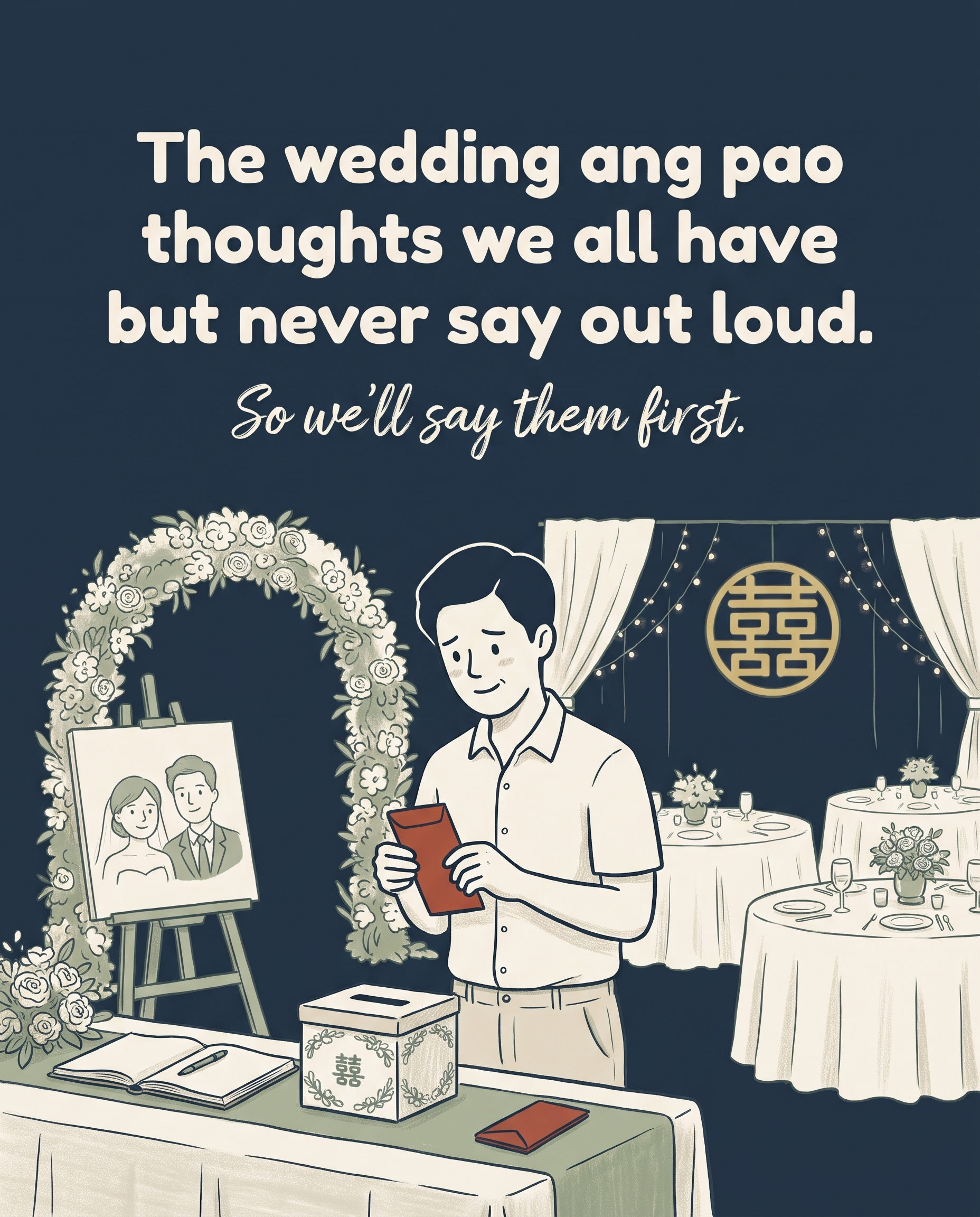
The wedding ang pao thoughts we all have
A wedding card lands on the table. You're happy for them, you really are. Then, before you've even checked the date, a smaller voice in your head asks: "Market rate now how much ah?"
Nobody says the rest out loud at the dinner, so we'll say it for you. These are composites of things people tell us and things we've caught ourselves thinking. They're not quotes from real people, but you'll probably recognise a few.
- "Do I follow the hotel market rate, or how close we are?"
- "Never go also must give the full ang pao ah?"
- "Last time they gave us that much, so must at least return the same."
- "Four weddings this year. Happy for them, but my wallet is crying."
- "I don't know the market rate, and too paiseh to ask."
Why the ang pao feels so loaded
A wedding is about two people, but the ang pao is the only part of it anyone can put a number on. You can't measure how much you care about a friend. You can measure what's inside the red packet, so that number ends up carrying a lot of weight it was never meant to carry.
Timing makes it heavier. According to the Department of Statistics, the median age at first marriage in 2025 was 31.1 for grooms and 29.6 for brides. That means most of your friends, cousins and colleagues tend to marry within a few years of each other, usually somewhere in your late 20s and early 30s. Singapore registered 24,688 marriages in 2025, 6.2% fewer than in 2024, but when your own circle hits that age, it can still feel like every month brings another card.
There's also the quiet record-keeping. Some families note down who gave what at their own wedding, and some couples do the same. So when it's your turn to give, it can feel like someone is keeping score, even when nobody is.
Five thoughts, and our take on each
Hotel market rate or how close you are
The hotel sets the market rate, but you know the friendship. We think how close you are is a fair guide too. A long-time friend at a simpler venue can matter more to you than an acquaintance at a grand ballroom, and that's allowed.
Not going, but still giving
There's no fixed rule here. We think a smaller ang pao with a proper message still counts. What most couples want from a friend who couldn't make it is to know they cared.
Returning the same amount
Matching what they gave you is a fair place to start. A lot can change in a few years, though, including the friendship itself, and we think the friendship as it is today matters more than the number from last time.
Four weddings in one year
Being happy for them and feeling the pinch can both be true. Knowing roughly what this year's ang paos add up to can make wedding season feel less heavy.
Not knowing the market rate
Asking is more common than it looks. Most people quietly check with a friend first, and nobody thinks less of them for it.
Set your own ang pao amounts: a 15-minute self-check
The point is to decide once, calmly, so you're not deciding in the car park outside the hotel.
Step 1: List the weddings you know about. Write down every invite you've received or expect in the next 12 months. Include the ones you're unsure about.
Step 2: Sort them into three groups. Close friends and family. Friends and colleagues you see regularly. People you've met once or twice.
Step 3: Check the market rate for each venue. Ask a friend who's been to similar weddings, or someone in the same circle. You don't need an exact figure, just a rough sense of the range.
Step 4: Decide where you sit for each group. For close friends, you might go a bit above. For "met once only" invites, you might stay near the lower end, or send a gift and a message if you're not attending.
Step 5: Add it up and look at it honestly. Compare the total with what you can comfortably spend this year without dipping into savings you've set aside for something else.
A made-up example. Rachel (not a real person) has five invites this year. Two are close friends, two are colleagues and one is a cousin's friend she's met once. She asks her sister about the rough market rate at each venue. She decides to go slightly above for the two close friends, stay near the market rate for colleagues, and send a card and a smaller ang pao for the one she can't attend. When she adds it up, the total is more than she expected, so she spreads it across the months and trims her own dining-out budget for the busiest stretch. Now she knows roughly what each card will cost before she opens it.
Scripts for the awkward bits
These are rough wording ideas. Change them to sound like you.
Asking a friend about the market rate: "Eh, you going to their wedding? Roughly what's the market rate there ah? I've no idea for that hotel."
When you can't attend: "So sorry I can't make it, I'll be overseas that weekend. Wishing you both the best day. I'll pass you something when I'm back."
When money is tight this year: You don't owe anyone an explanation about your finances. A warm message, turning up on time and staying for the toast all count. If it helps, tell a close friend you're keeping things simple this year. Most people understand more than we expect.
Where to get help
Wedding season is usually a short-term pinch, but if it's pushing you onto credit cards or loans, it's worth getting help early.
| Support | What it gives you | Who it's for | How to start |
|---|---|---|---|
| MyMoneySense | A free government planning service with a budgeting tool, savings targets and a dashboard of your finances. It is not tied to any financial product. | Singapore citizens who want to see where their money goes | Log in with Singpass and set up your dashboard |
| Credit Counselling Singapore | A non-profit that helps people with unsecured debt through counselling, education and repayment arrangements. Its Debt Management Talks are free. | Anyone whose card or personal loan debt is getting hard to manage | Attend a Debt Management Talk, then submit a Counselling Request Form |
| MAS Financial Institutions Directory | Lets you check whether a firm is licensed or regulated by MAS. | Anyone about to speak to a financial adviser | Search the firm's name before you meet them |
If you're on the other side
If you're planning a wedding, please don't read this as guests resenting you. A friend who worries about the market rate still wants to celebrate with you. Most guests are just happy to be invited.
Some honest caveats
Not every wedding runs on ang paos. Malay, Indian and other weddings in Singapore have their own customs, and some couples say "no ang pao, just come". Their wish comes first.
Market rates differ by venue, by circle and by family, and they shift over time. We haven't listed any amounts on purpose, because any number we printed would be wrong for someone.
If money is tight right now, a smaller ang pao with a proper message is still a blessing. Nobody should feel they have to borrow to attend a wedding.
Our 5 cents
Years later, most couples won't remember how much you gave. They remember how you made them feel on the day. The one ang pao people do tend to remember is the lowest one, way off the market rate, and who gave it. As long as yours isn't that one, we think you're fine.
Everyone's money situation is different. We think the right amount is one that fits your own situation and that you feel comfortable giving. Deciding your own rough amounts before the next invite arrives takes the stress out of the car park, and leaves you free to enjoy the dinner.
This post is our opinion and general commentary, not financial advice. We are not licensed financial advisers. Everyone's circumstances are different — please speak to a MAS-licensed adviser before making any financial decisions.
Sources
- Department of Statistics Singapore: Statistics on Marriages and Divorces, 2025 (10 July 2026)
- Department of Statistics Singapore: Statistics on Marriages and Divorces, 2025 (news release page)
- GovTech: MyMoneySense overview
- Credit Counselling Singapore
- Monetary Authority of Singapore: Financial Institutions Directory
Enjoyed this? Follow @fivecents.co on Instagram for more.