
Retrenched and Blaming Yourself? Why It's Rarely Your Fault, and How to Build Options
· 8 min read
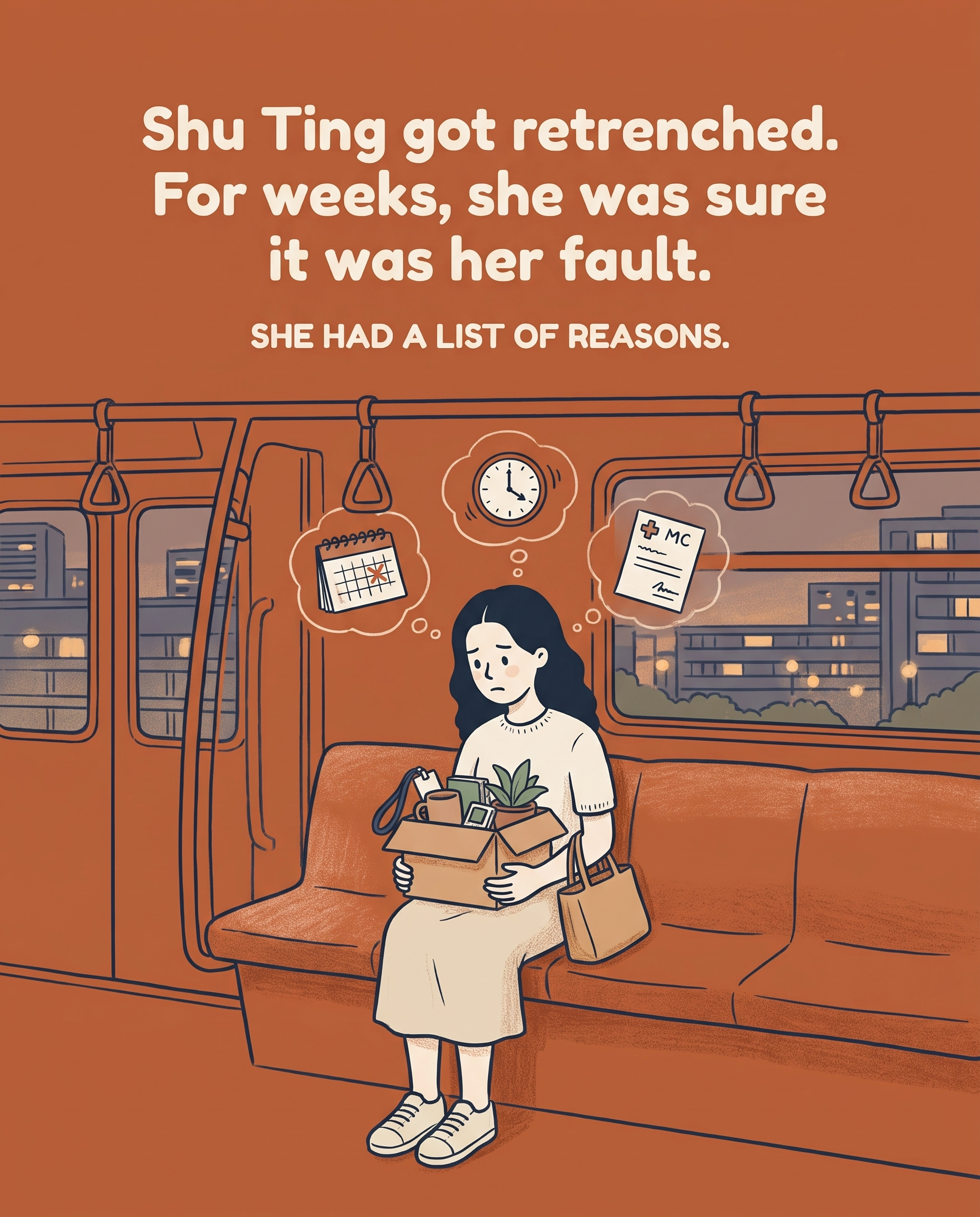
Was it my fault?
Shu Ting is made up, but her week isn't hard to picture.
At 9am a calendar invite arrived: "Quick chat". Cameras off. Someone from HR read from a script. By noon her laptop was locked. Four years of work, gone in one call.
On the MRT home, the list started.
- "The deadline I missed in March."
- "The meeting where I pushed back."
- "That week I took MC."
- "Maybe that's why it was me."
On Monday her 7am alarm still rang, and she had nowhere to be. For four years the job had her weekdays and most of her weekends. Now the week had a hole in the middle, and so did she.
If you've been retrenched, or you're scared you might be, this guide is for the list in your head. It covers why we blame ourselves, what a retrenchment usually is, how to sort a real lesson from plain guilt, and how to start building options so one job isn't holding up everything.
Why your brain makes the list
When something bad happens, we look for a reason we can control. "I messed up" hurts, but it also comes with a fix: do better next time. "It had nothing to do with me" can feel worse, because it means it could happen again whatever you do.
So the brain picks the story that feels more manageable, even when it isn't true. The missed deadline, the MC, the one meeting where you spoke up all get dragged in as evidence.
There's also the way it's delivered. The email has your name on it, the call is with you, the letter is addressed to you. Everything about it feels personal, even when the decision was made somewhere far from your desk.
What a retrenchment usually is
Most retrenchments start in a budget meeting, long before anyone's name comes up. A company's growth slows, teams get merged, a product line closes, and the number of roles is set first. Names come later.
This week showed it at scale. On 4 November 2026, Canva said it was cutting 22% of its staff, about 1,271 people, and its CEO wrote that growth had "slowed for the first time in a decade" (TechCrunch). The company said everyone affected would get at least six months of salary, inclusive of statutory entitlements (IBTimes Singapore).
Twelve hundred people can't all have missed a deadline.
In Singapore, MOM's guidance follows the Tripartite Advisory on Managing Excess Manpower and Responsible Retrenchment. On its Responsible retrenchment page, MOM says:
- Employees with at least 2 years' service are eligible for a retrenchment benefit. Those with less than 2 years could be granted an ex-gratia payment out of goodwill.
- The prevailing norm is 2 weeks to 1 month of salary per year of service, depending on the company's financial position and industry. In unionised companies where the amount is in the collective agreement, the norm is 1 month per year.
- Salary, unused annual leave and notice pay are paid on the last day, and retrenchment benefit is not subject to CPF contributions.
- Employers with at least 10 employees must notify MOM within 5 working days of informing an employee of their retrenchment.
MOM also told Parliament in February 2026 that, from 2020 to 2025, around 9 in 10 eligible employees at companies with 10 or more staff received retrenchment benefits, and around 8 in 10 of them got at least 2 weeks' salary per year of service (MOM written answer, 4 Feb 2026).
If you need the practical first-week steps (what to get in writing, how to work out how long your savings last, what to tell family), our earlier guide covers them: Retrenched in Singapore? What to Do in the First Week.
Lesson or guilt? A 10-minute sort
It's fair to look back once. Doing it on purpose, with a time limit, stops it from running on a loop at 2am.
- Write the list down. Every reason your brain has offered. Don't edit it.
- Next to each one, ask: would this alone have cut my role? Be honest both ways. A missed deadline months ago rarely decides a company-wide cut. A role that was being phased out for a year might.
- Ask: is there something here I'd do differently in any job? Not "to avoid being retrenched", which you can't control, but because it'd make work or life better.
- Keep one item, at most two, as a lesson. Cross the rest out. Those are guilt, and guilt doesn't help with the next interview.
- Write the lesson as one sentence you'd tell a friend. If it sounds cruel out loud, it's still guilt.
An example, with made-up details: Shu Ting's list had five items. The missed deadline, the MC and the meeting failed step 2 straight away. One item survived: she'd given the job her weekdays and most of her weekends, so when it ended, almost nothing else in her week was hers. That was the lesson she kept.
Giving her best was never the mistake. She just wished she'd kept a little of herself outside the job.
Job security looks different now
Many of us grew up hearing that security meant joining a big, stable company and staying. This week is a reminder that big companies cut roles too.
Our view: job security isn't joining a big company. It's knowing that whatever happens, you'll have options. And you can start building that bit by bit, from wherever you are.
That means working on yourself, as well as in your job. Here are four small ways, and you only need one or two.
Apply for a role now and then, even when you're happy. Browsing listings shows you what companies advertise. An application and an interview show you what someone would actually offer, and they keep your interview skills from going rusty. MyCareersFuture is the government job portal, run by the Skills and Workforce Development Agency and GovTech, and a reasonable place to start.
Pick up one skill your next job might need. Look at three or four job ads for the role you'd want next, note what keeps coming up that you don't have yet, and choose one.
Stay active socially, and in touch with people outside your company. Old colleagues, friends in other industries, a community you're part of. Many jobs come through someone who knew you were looking, and these people also remind you that you're more than a job title.
Start a side hustle, if you have the energy for it. It doesn't need to replace your pay. It gives you something that's yours, and a skill set that doesn't depend on one employer. Our side hustle guide covers what to check first, including tax.
Pick one or two. Doing all four on top of a full-time job is how people burn out.
A quick options check
Answer these honestly. It takes five minutes, and there are no right scores.
- If my job ended tomorrow, do I know roughly what someone else would pay me?
- When did I last update my CV? Could I send it this week?
- Can I name three people outside my company I could message about work?
- Is there one skill I've been meaning to learn that keeps showing up in job ads?
- How many hours a week are mine, outside work and chores?
If most of these feel uncomfortable, that's normal. You don't need to fix them all. Choose the one that feels easiest and start there.
Where to get help in Singapore
| Support | What it is | Who it's for | How to start |
|---|---|---|---|
| NTUC e2i | Career services, job support and skills upgrading; has a retrenchment support section and career coaches | Workers in Singapore, including those recently retrenched | Find an e2i Career & Jobs Centre or book a career coach on the e2i site |
| MyCareersFuture | Government job portal that matches jobs to your skills | Anyone looking for work, employed or not | Create a profile and search by role or skill |
| ComCare (MSF) | Financial help for daily living expenses, including temporary support for people looking for a job | Individuals and families who need help with basic living needs | Call 1800-777-0000 (24 hours) or check eligibility on SupportGoWhere |
| MOM: Responsible retrenchment | What employers are expected to do and pay when retrenching | Anyone being retrenched or checking their package | Read the page and compare it with your retrenchment letter |
| Our first-week guide | Checklist, savings runway steps and a wider support table, including SkillsFuture Jobseeker Support | Anyone in the first weeks after a retrenchment | Start with the checklist |
Scheme rules change. Check each official page before you rely on it.
Some honest caveats
- If you're going through this right now, we're sorry. Go easy on yourself. There's no deadline for feeling okay again.
- Sometimes an exit really is about performance. Retrenchment is about roles, and if you're not sure which applied to you, it's fair to ask HR to put the reason in writing.
- Not everyone has spare hours. If you're caring for family or working two jobs, one small thing counts, and so does doing nothing for a while.
- If you're older or in a shrinking industry, the search can take longer. That says nothing about your worth.
Our 5 cents
Getting retrenched says more about the company than about you. Don't let one email tell you otherwise.
Look back once for one lesson, then stop. And if there's a lesson for all of us, it's the one Shu Ting found: your job can be part of who you are, just don't let it be all of you.
If your job ended tomorrow, what options would you already have? And which one small thing could you start this month?
This post is our opinion and general commentary, not financial advice. We are not licensed financial advisers. Everyone's circumstances are different — please speak to a MAS-licensed adviser before making any financial decisions.
Sources
- TechCrunch: Canva lays off over 1,200 people amid slowing growth (4 Nov 2026)
- IBTimes Singapore: Canva layoff affects 1,271 employees (4 Nov 2026)
- MOM: Responsible retrenchment (updated 14 Jul 2026)
- MOM: Written answer on compliance with tripartite guidelines for retrenchment benefits (4 Feb 2026)
- NTUC e2i
- MyCareersFuture
- MSF: ComCare
Enjoyed this? Follow @fivecents.co on Instagram for more.